

Jeep Only · Fixed Ops · Las Vegas
Selecting the Right Jeep Tires for Las Vegas Desert and Trail Driving
Mojave heat, sharp volcanic rock, and hot asphalt each punish rubber differently. Get matched with the correct tread, load range, and rotation strategy from the Jeep Only service team on West Sahara.
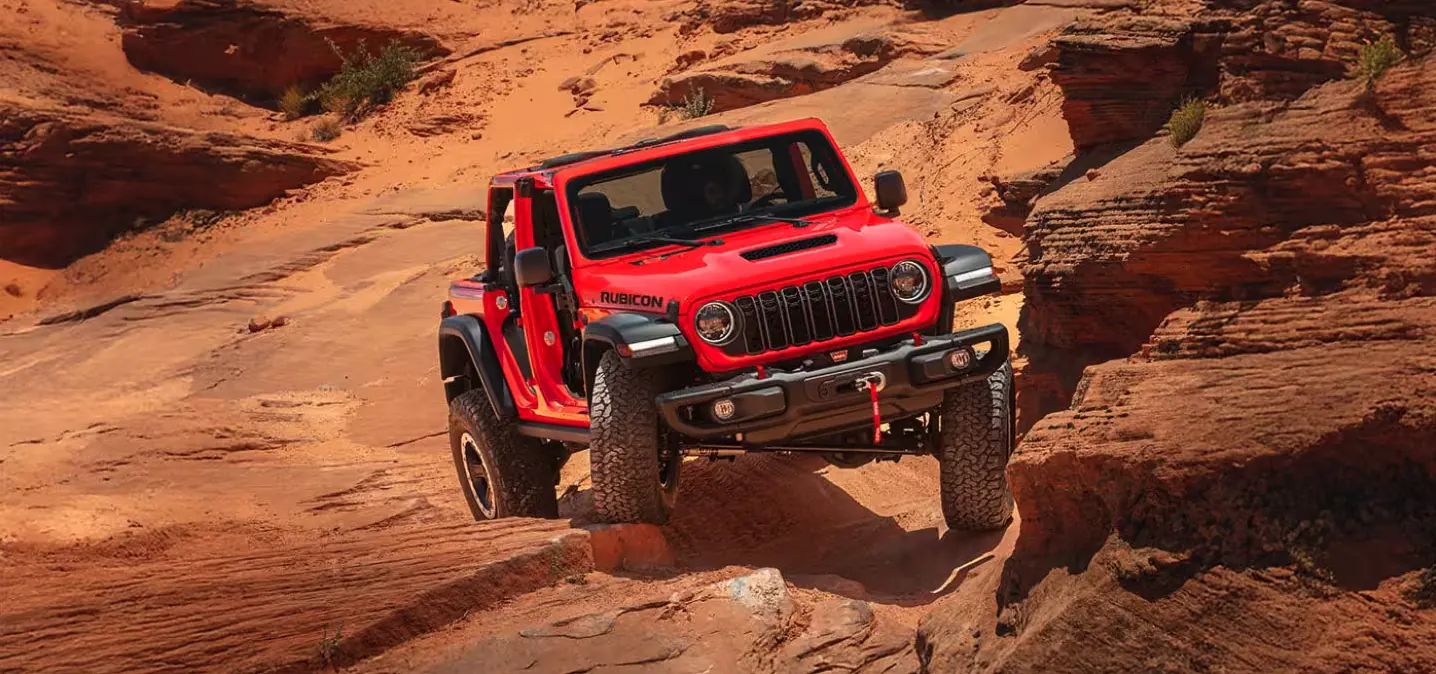
Desert-Ready Since Day One
5,000mi
Rotation Interval
5-Tire
Wrangler Pattern
4/32″
Off-Road Min Depth
115°F+
Vegas Pavement Temp
Built for the Mojave
Trail-Ready Tire Strategy Starts Here
Operating a 4x4 in the Mojave Desert requires a tire strategy built around extreme heat and abrasive surfaces. The sustained summer temperatures in the local basin accelerate rubber compounding degradation, while sharp limestone and volcanic rock formations demand robust construction. Selecting the appropriate tread design and carcass composition ensures your vehicle maintains traction and structural integrity whether navigating urban corridors or exploring remote back roads.
For those who frequently travel toward the open, arid landscapes around Henderson, tire selection directly impacts off-road self-reliance. The rocky and sandy terrain of the nearby Black Mountains requires tires with reinforced sidewalls to prevent punctures from sharp desert flora and jagged rock shelves. A tire that performs flawlessly on a smooth highway can easily suffer a sidewall failure when aired down over sharp Mojave gravel. Our certified technicians help you evaluate your typical driving split to find a tire that balances daily commuting needs with weekend trail protection.
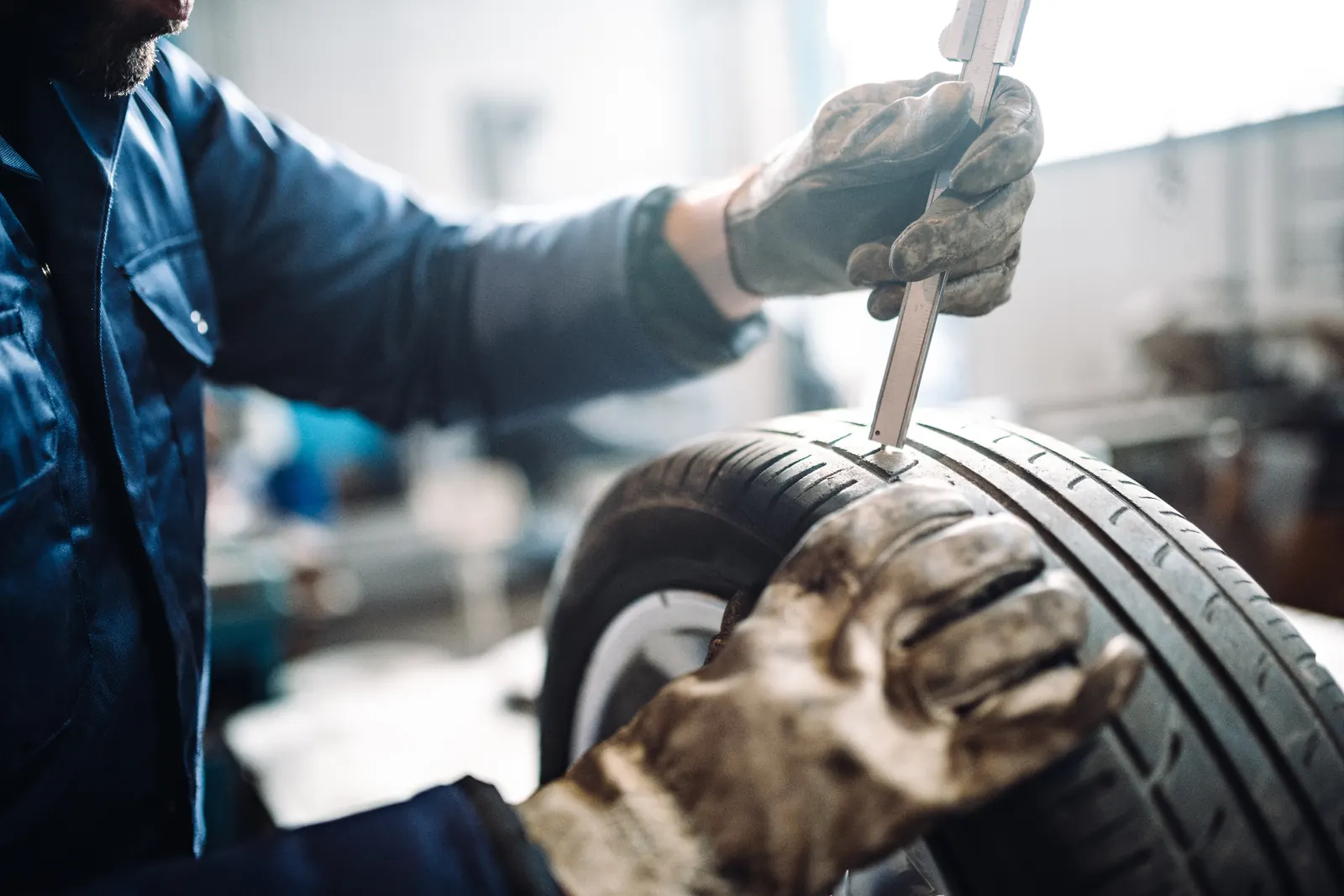
At Jeep Only, we specialize in maintaining your vehicle's trail-ready status with precise tire matching, mounting, and balancing services.1 If you notice uneven wear, vibration, or a loss of traction on loose dirt, it is time to have your tire setup inspected by our specialists. You can easily schedule your service today through our online portal to have our team evaluate your current tread condition.
To help keep your maintenance costs manageable, we regularly update our service and parts offers. Before booking your appointment, be sure to view new Jeep specials for current opportunities, or check out our dedicated program page to view Jeep incentives on certified maintenance packages. For direct assistance or to speak with a service advisor about your specific tire needs, you can reach our service department directly by giving us a quick call. If you prefer to drop by for a physical inspection of your tread, you can easily find us on West Sahara Avenue by getting directions to Jeep Only.
Overview
- 01Mud-Terrain vs All-Terrain Tires for Rock Crawling on Nevada Trails
- 02Choosing Load Range C, D, or E Tires for Sharp Rocky Terrain
- 03The Correct Five-Tire Rotation Pattern for Jeep Wrangler 4WD Systems
- 04When to Replace All-Terrain Tires: Safe Off-Road Tread Depths
- 05Understanding Road Hazard Warranties and Installation Hardware Costs
- 06Types of Tire Wear & What They Reveal
- 07Common Questions About Off-Road Tire Care and Desert Performance
- 08FAQs: Jeep Tires & Tire Rotations in Las Vegas
01 · Tread Selection
Mud-Terrain vs All-Terrain Tires for Rock Crawling on Nevada Trails
Are you trying to decide between mud-terrain and all-terrain tread patterns for your weekend trail excursions? This is one of the most common debates among off-road enthusiasts. While mud-terrain options feature aggressive, wide-open tread blocks designed to self-clean thick mud, they behave differently on dry, rocky surfaces. On the dry sandstone and slickrock common to southern Nevada, all-terrain tires often provide a superior contact patch because their tighter tread patterns place more rubber in direct contact with the rock surface, creating more biting edges for dry traction.
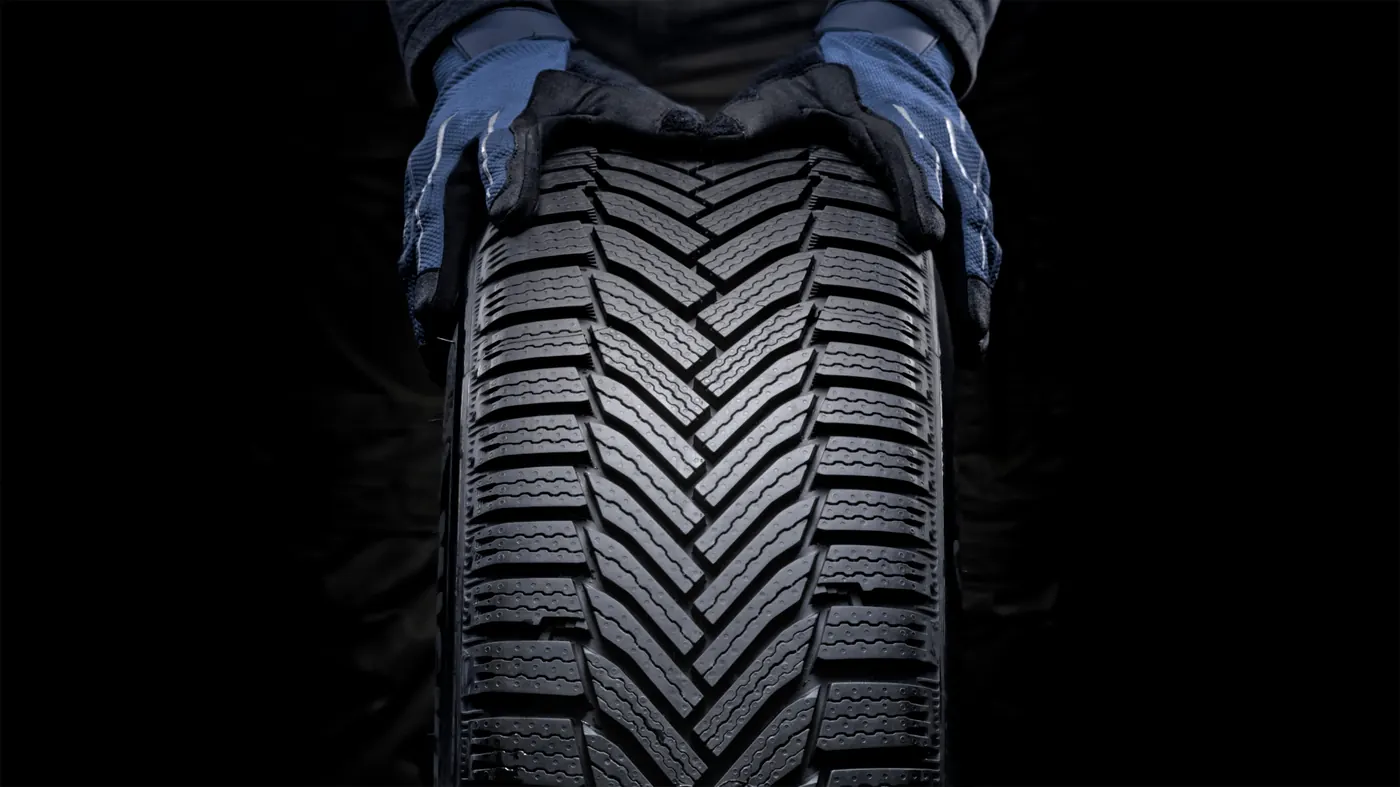
Mud-terrain tires use deep void spaces that can occasionally suffer from "tread chunking" when subjected to the high torque of crawling over sharp, abrasive obstacles. Conversely, modern all-terrain tires are engineered with specialized cut-and-chip resistant rubber compounds designed to withstand the grinding forces of desert rock crawling. For a daily-driven 2026 Jeep Wrangler Rubicon, which comes standard with 33-inch tires in an LT285/70R17 size, all-terrain rubber provides a quieter highway ride and more predictable handling on hot asphalt while remaining highly capable on moderate trails.2
Selecting the right tire pattern also involves managing the extra weight of aggressive tread designs. Heavier mud-terrain tires increase unsprung weight, placing additional stress on your steering linkage, ball joints, and suspension bushings. If you decide to upgrade your vehicle's capabilities, you can order genuine Jeep parts directly through our department to ensure your steering stabilizers and suspension components are rated for the heavier rolling mass. If you have questions about fitment limits on a stock suspension, please contact our team to consult with an experienced service advisor.
02 · Load Range
Choosing Load Range C, D, or E Tires for Sharp Rocky Terrain
Which ply rating is truly necessary to prevent a sliced sidewall on rugged desert trails? The answer lies in understanding tire load ranges, which denote the load-carrying capacity and inflation limits of a tire carcass.
Load Range
C
6-PLY EQUIVALENT
Highly flexible sidewall that conforms beautifully to rocks when aired down, providing a comfortable ride on both pavement and light dirt.
Load Range
D
8-PLY EQUIVALENT
Middle-ground compromise offering increased puncture resistance without excessive stiffness on the daily commute.
Load Range
E
10-PLY EQUIVALENT
Heavy-duty construction with ultra-stiff sidewalls, highly resistant to sharp rock punctures but with a firmer, sometimes harsh ride.
For a lighter vehicle like a two-door 2026 Jeep Wrangler Sport S, a heavy Load Range E tire can feel overly stiff because the vehicle lacks the curb weight to flex the rigid carcass, even at lower tire pressures. However, if you drive a heavier vehicle like the 2026 Jeep Gladiator Mojave—which has a curb weight of 4,695 lbs and a towing capacity of 4,500 lbs—or if you regularly haul heavy gear, a higher load range is essential to support the payload and resist sidewall pinch flats on rocky trails.2
Because heavy-duty tires run hotter and put different wear patterns on your tread, maintaining a strict service schedule is vital. To keep your vehicle running smoothly, you can schedule your oil change and tire inspection online to have our technicians check your tire pressures and wear patterns. For more information on our complete range of certified maintenance services, feel free to visit our homepage.
03 · Rotation Strategy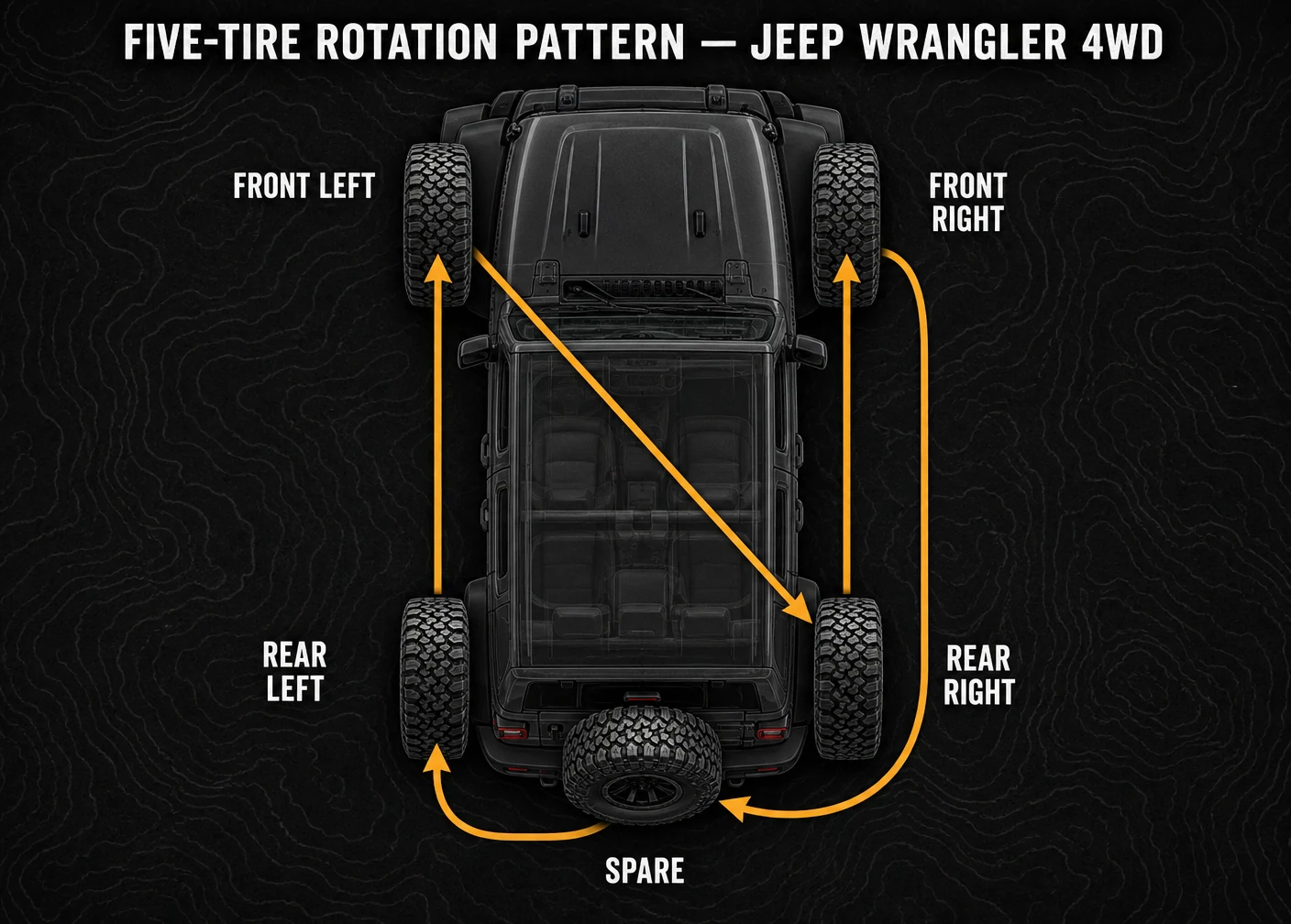
The Correct Five-Tire Rotation Pattern for Jeep Wrangler 4WD Systems
How do you maximize the lifespan of your off-road tires when your vehicle carries a full-size spare? Jeep vehicles equipped with a matching spare tire should always utilize a 5-tire rotation pattern rather than the standard four-wheel swap. This practice ensures that all five tires wear down at an identical rate, preventing driveline binding. If you drive a four-wheel-drive system with mismatched tire diameters—which can happen if you run four partially worn tires and then install a brand-new, full-depth spare in an emergency—the difference in rotational speed can place severe stress on your transfer case and differentials.1 The industry-standard 5-tire rotation sequence for a rear-wheel-drive-based 4WD system follows a specific path:
Five-Tire Rotation Pattern · Jeep Wrangler 4WD
- The rear tires move straight forward to the front axle (Left Rear to Left Front; Right Rear to Right Front).
- The left front tire crosses diagonally to the right rear position.
- The right front tire becomes the new spare tire mounted on the tailgate.
- The spare tire is introduced directly to the rear passenger side (Right Rear).
Performing this service every 5,000 miles to 7,000 miles helps prevent the cupping and heel-toe wear common to aggressive tread blocks. During your rotation visit, our technicians also perform a comprehensive brake inspection to check pad thickness and rotor condition. You can easily schedule brake service and tire maintenance together to keep your entire stopping system in peak operating condition.
04 · Replacement Timing
When to Replace All-Terrain Tires: Safe Off-Road Tread Depths
At what point does an all-terrain tire lose its effectiveness on the trail? While passenger car tires are legally considered worn out at a tread depth of 2/32 of an inch, this limit is insufficient for off-road safety. For reliable traction on loose dirt, gravel, and wet rocks, all-terrain tires should be replaced once they wear down to 4/32 of an inch or 5/32 of an inch of remaining tread depth. Below this level, the tread voids are too shallow to bite into loose terrain, and the tire's self-cleaning capabilities drop off dramatically.
| Tread Depth | Operational Capability & Safety Guidance |
|---|---|
| 10/32″ and above | Optimal off-road traction and deep-soil bite |
| 6/32″ to 8/32″ | Good trail performance; normal wear range |
| 4/32″ to 5/32″ | Minimum safe limit for off-road trail driving |
| 3/32″ and below | Highway use only; prone to trail punctures |
| 2/32″ | Legal limit; immediate replacement required |
In addition to physical tread depth, the intense heat of the desert sun causes rubber to dry out and crack over time. This condition, known as dry rot, compromises the structural integrity of the tire and increases the risk of a high-speed blowout on the highway. Our service department inspects both the tread depth and the age of your tires during every multi-point inspection. To stay informed on tire safety technology and maintenance tips, you can read our latest news online. If you are interested in seeing how different tire packages look on our latest models, feel free to view featured vehicles currently highlighted at our location.
05 · Coverage & Installation
Understanding Road Hazard Warranties and Installation Hardware Costs
What does a road hazard warranty actually cover when you damage a tire on the trail? Most standard manufacturer warranties only cover defects in workmanship and materials, leaving you responsible for tires damaged by road debris or sharp rocks. To protect your investment, our dealership offers dedicated road hazard protection plans. These plans typically cover the cost of repairing or replacing a tire damaged by nails, glass, or sharp trail obstacles during the first 12 to 24 months of ownership, providing peace of mind when exploring rugged terrain.3
When purchasing new tires, it is important to understand what is included in the base tire price versus installation fees. The cost of the tire itself covers the rubber carcass, but mounting and balancing require specialized hardware. Standard professional installation fees typically charge a nominal fee per tire for essential hardware:
- New brass or rubber valve stems to ensure a reliable seal.
- TPMS sensor rebuild kits (including new seals and retaining nuts) to prevent slow air leaks.
- Precision wheel weights to eliminate high-speed steering wheel vibrations.
Our service advisors believe in complete transparency, providing a clear breakdown of all parts, hardware, and labor before work begins on your vehicle. To learn more about our commitment to straightforward service, you can meet our staff online or speak with a service advisor directly at our service desk.
06 · Diagnose the Damage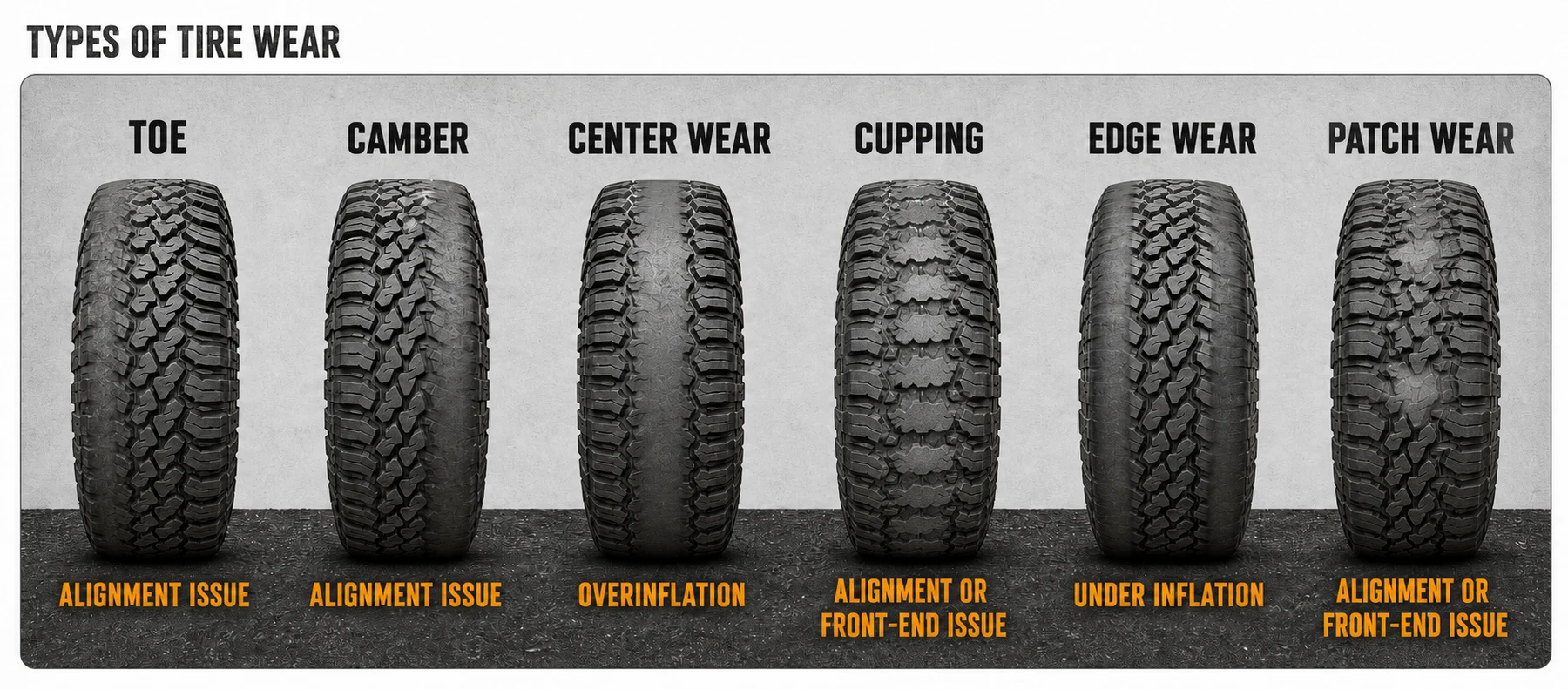
Types of Tire Wear & What They Reveal
The pattern of wear on a Jeep's tread is one of the fastest ways to diagnose an alignment, inflation, or suspension issue before it becomes a costly repair. Compare your tread to the six common wear signatures below and bring the vehicle in for a full inspection if any of them look familiar.1
Trail-Ready Services
Book Every Wheel & Tire Service in One Stop
From mount & balance to rotations, brake checks, and OEM part upgrades — our Jeep-only technicians keep every corner of your rig dialed in.




07 · Trail Answers
Common Questions About Off-Road Tire Care and Desert Performance
Which tire type provides better fuel economy on a Jeep?
Highway terrain tires provide lower rolling resistance and can improve a Jeep's fuel efficiency by 1 mpg to 3 mpg compared to heavier, more aggressive all-terrain or mud-terrain tires. For example, a 2026 Jeep Grand Cherokee Altitude 4x4 achieves an EPA-estimated 21 city / 26 hwy mpg partly due to its optimized factory-equipped tires, which minimize rolling resistance.2 If you transition to a heavy, high-void all-terrain tire, expect a slight drop in overall fuel efficiency.
Do 35-inch tires fit on a stock Jeep Wrangler without a lift kit?
A stock 2026 Jeep Wrangler Rubicon equipped with high-clearance fender flares can accommodate 35-inch tires with minimal rubbing under normal driving conditions. However, non-Rubicon trims, such as the Sport S, feature standard fender flares and will require at least a 2-inch suspension lift to clear 35-inch tires without rubbing against the body panels during suspension articulation.
How does desert heat affect tire pressure in southern Nevada?
Sustained summer heat causes tire pressures to fluctuate significantly, rising by approximately 1 psi for every 10-degree Fahrenheit increase in ambient temperature. In the local desert climate, this means a tire set correctly in the cool morning can easily become over-inflated during a hot afternoon drive, leading to center tread wear and a harsher ride. We recommend checking your tire pressures cold before driving.
What is the risk of airing down tires without beadlock wheels?
Airing down your tires increases your traction envelope on sand and rocks, but dropping below 15 psi on standard wheels runs the risk of the tire bead separating from the wheel rim. Beadlock wheels physically clamp the tire bead to the wheel, allowing you to run single-digit tire pressures safely, whereas standard wheels require moderate pressure to keep the tire inflated and mounted.
Can a single damaged tire be replaced on a permanent 4WD system?
If the remaining three tires have more than 3/32 of an inch of tread wear, replacing only one tire can cause driveline strain due to the difference in rotational speed. In this scenario, it is best to replace tires in pairs or as a set of four, or have the new tire professionally shaved down to match the tread depth of the existing tires to protect your 4WD system.
To learn more about our service philosophy and our commitment to desert-ready vehicle preparation, you can learn about our dealership online.
Call (888) 559-6420If you are ready to have your current tire setup inspected, rotated, or replaced, you can reach our service department directly by calling (888) 559-6420. Our state-of-the-art facility is conveniently located at 5255 W Sahara Ave, Las Vegas, NV 89146, and you can easily get customized driving directions by checking our map location before heading over.
08 · FAQs
Frequently Asked Questions About Jeep Tires and Tire Rotations in Las Vegas
How often should I rotate the tires on my Jeep?
Most Jeep tires should be rotated every 5,000 to 8,000 miles, although the exact interval depends on the model, tire type, and driving conditions. Check your Jeep owner's manual for the recommended schedule.
Las Vegas heat, abrasive pavement, and off-road driving can accelerate uneven tread wear. Having the tires inspected during each oil change can help determine whether an earlier rotation is needed.
Why are regular tire rotations important for a Jeep?
Tire rotations help distribute wear more evenly across all four tires. Front tires experience different steering and braking forces than rear tires, which can cause certain positions to wear faster.
Consistent rotations may extend tire life, improve handling, and help maintain similar tread depths across a Jeep's four-wheel-drive system.
Should the full-size spare be included in a Jeep Wrangler tire rotation?
A full-size spare should generally be included in a five-tire rotation when it matches the other four tires in size, tread pattern, construction, and wheel specifications. This allows all five tires to wear at a similar rate.
Temporary or nonmatching spare tires should not be included. A technician should verify that the spare is compatible and in good condition before adding it to the rotation pattern.
What tire rotation pattern should be used on a four-wheel-drive Jeep?
Many four-wheel-drive Jeeps use a crossing rotation pattern that moves tires between the front and rear axles. Jeeps with a matching full-size spare may require a separate five-tire rotation sequence.
Directional, staggered, or differently sized tires may have limited rotation options. Always follow the pattern listed in the owner's manual or recommended by a qualified Jeep service technician.
How can I tell when my Jeep tires need to be rotated?
Common signs include uneven tread depth, increased road noise, reduced traction, or visible differences between the front and rear tires. Aggressive all-terrain tires may also develop cupping or stepped tread-block wear.
Vibration, pulling, or one-sided wear may indicate an alignment, balancing, inflation, or suspension problem rather than a rotation issue alone.
Is a tire rotation the same as wheel balancing or alignment?
No. A tire rotation changes where each tire is positioned on the vehicle. Wheel balancing corrects uneven weight within a tire-and-wheel assembly, while alignment adjusts the angles of the suspension and wheels.
Vibration may indicate a balancing issue, while pulling, an off-center steering wheel, or edge wear may point to an alignment problem. A technician can determine which service is needed.
Do Jeep tires need to be balanced every time they are rotated?
Jeep tires do not normally need to be balanced during every rotation. Balancing may be recommended when there is highway-speed vibration, uneven tread wear, a missing wheel weight, or a newly mounted or repaired tire.
A rotation can sometimes make an existing imbalance more noticeable because the affected tire has moved to a different position on the Jeep.
Can rotating the tires fix uneven tread wear?
A tire rotation may help slow additional uneven wear, but it cannot restore tread that has already worn away. The underlying cause must also be identified and corrected.
Uneven wear may result from improper inflation, poor alignment, wheel imbalance, or worn suspension components. Severely damaged or irregularly worn tires may need to be replaced instead of rotated.
Should I schedule my Jeep tire rotation with an oil change?
Scheduling a tire rotation with an oil change is a convenient way to stay on top of routine maintenance. The service intervals are often similar, making it easier to inspect the tires regularly.
During the visit, technicians can also check tire pressure, tread depth, brake condition, and signs of alignment or suspension problems.
What tire pressure should I use after rotating my Jeep tires?
Use the cold tire pressure listed on the Tire and Loading Information label inside the driver's door area. Do not use the maximum pressure printed on the tire sidewall as the normal inflation setting.
Check pressure before driving or after the Jeep has been parked for several hours. Las Vegas heat can temporarily increase tire pressure, so avoid releasing air from tires while they are hot.
When should Las Vegas drivers replace their Jeep tires?
Jeep tires should be replaced when tread reaches the minimum safe depth, structural damage is present, or the tires can no longer provide dependable traction. Off-road drivers may need replacement before the legal tread limit because shallow tread performs poorly on sand, gravel, and rocky terrain.
Cuts, bulges, exposed cords, deep cracking, or repeated air loss require immediate inspection. Tire age should also be considered because prolonged Las Vegas heat can contribute to rubber deterioration.
Jeep Only · 5255 W Sahara Ave
Ready to Trust Your Tires to Jeep-Only Technicians?
Schedule an inspection today and let our certified team match your driving split, tread pattern, and load range to Las Vegas conditions.